GlyntIQ Request a walkthrough Walkthrough

Built for Diabetes care-management orgs & endocrinology clinics

Readings become care.Months become revenue.

GlyntIQ pre-reads every glucose stream and shows your team what requires attention. CGM and meter data becomes patient coaching, a ranked worklist for your care managers, and billing evidence assembled per patient, per month — so a bigger panel doesn't mean a bigger backlog.

GlyntIQ — what the name means

Blood Glucose Intelligence.

GlyntIQ transforms continuous glucose data — together with nutrition, medication, sleep and activity — into personalized, actionable intelligence.

Nothing left unbilled Device days and consultation time are tracked as they happen, so months that qualify stop slipping through at month-end.
Hours back to patients The reading, ranking and documenting are done before your team sits down. The day starts at act.
Months you can still save Patients a single day short of qualifying, surfaced while the month can still be recovered.

Data in

One stream. Readings and context.

The meters and CGMs your patients already use, the cuffs and scales beyond glucose, and the meals, medication, sleep and activity that move the numbers — all converge into one normalized stream. Your care managers see one patient, not one inbox per device brand.

No smartphone. No wifi. No pairing. No app. The patient tests — the reading arrives.

Cellular meters carry the panels phone-tethered devices fail: older patients, rural patients, patients who never installed anything.

One system

Spend the month on patients, not portals.

4 systems that don't
talk to each other

A device portal, the EHR, a billing spreadsheet and a texting tool — your care managers stitch them together by hand. GlyntIQ makes them one.

The month, re-divided

The overhead becomes software. The minutes go back to patients.

Finding the work, preparing to act, documenting it, proving it to the payer — that is where a care manager's month goes today. When software absorbs it, the same team carries a bigger panel — growth without the headcount.

Illustrative split — the walkthrough shows the real thing.

What GlyntIQ does

Five jobs, done the same way every day.

Connect

Readings arrive on their own

Cellular meters and CGMs send readings without the patient doing anything — no cables, no uploads, nothing to set up.

  • Meters can ship straight to a new patient's door
  • Transmission gaps flagged while the month is still recoverable

Interpret

The stream is read before your team sits down

GlyntIQ turns raw readings into plain sentences: the pattern, when it happens, and what changed since last week.

  • Overnight and post-meal patterns surfaced, not buried in a chart
  • Logged meals paired with the glucose window around them
  • A plain-language summary per patient, ready before the call

Route

The day arrives as a worklist

Glucose events become work items, routed to the right role and ranked by who needs attention — nothing depends on someone remembering to check.

  • The panel ranked worst-first every morning
  • Each item carries the reason it surfaced
  • Stable patients remain on their scheduled cadence, while exceptions rise to the top

Engage

Coaching lands in the patient's own thread

Check-ins, education and nudges over the text and email the patient already has — in English or Spanish. A concerning answer routes to your team with the reason attached.

  • Nudges timed to the patient's own reading rhythm
  • Education matched to what this week's readings make relevant
  • Answers come back into the worklist, not into a shared inbox

Bill

The billing evidence assembles itself

Device-transmission days tracked per patient-month, consultation time counted as it happens, and the supported codes derived — RPM, CCM or PCM. Nothing reconstructed at month-end.

Patient month March · RPM
A Patient A
  • Device days 18 of 16
  • Time 24 min
  • Codes derived

99454 + 99457 · ready for the claim

Illustrative. Codes derive from tracked days and minutes.

Human-decided GlyntIQ reads, ranks and drafts. Your team decides — every time.

AI agents clinical & operational

A dedicated team of diabetes AI agents, so your people can do what they trained for.

They do the remembering, the checking and the writing-up — the hundred small things that eat a care manager's day. Nurses coach. Care managers manage. Nobody scrolls charts at 7pm.

Clinical

Work your clinicians would otherwise do at 7pm

  • Coaches the patient — glucose coaching, education and check-ins in English or Spanish, inside clinical guardrails.
  • Pairs meals with readings — each logged meal matched to the glucose window around it, ranked by impact.
  • Provides approved medication education — and routes clinical questions to the appropriate clinician.
  • Triages symptoms — a concerning answer routes to the care team with the reason attached.
  • Supports the whole patient — mental-health check-ins and nutrition coaching alongside the glucose.
  • Briefs the care team — what changed since last contact, before the next one.

Operational

Work your back office would otherwise chase

  • Watches device days — patients drifting under the billable threshold surface while the month can still be saved.
  • Counts the minutes — consultation time tracked as it happens, not reconstructed later.
  • Derives the codes — RPM, CCM and PCM codes per patient-month, from tracked evidence.
  • Flags the silent meters — a transmission gap becomes an outreach task, not a surprise.
  • Keeps enrollment moving — onboarding tracked from consent to first reading.
The rule Agents draft, watch and flag — they never adjust a medication. A human signs everything that touches a patient or a claim — and every action is on the record.

The dashboard era is ending

Diabetes care was a monologue.We made it a conversation.

Diabetes is not an information problem — it is an interpretation problem. A sensor patient generates over a hundred thousand readings a year, and both sides end up staring at the same data at the same time, neither able to use it. The sensor speaks. Almost nobody listens.

Monologue Conversation
The patient A number on a phone. No explanation, no plan. Coaching tied to the meal that caused it, in their own thread.
The clinician A fourteen-page report, and fifteen minutes to read it. A one-page brief, with the draft plan ready to sign.
The feedback loop The quarterly visit — reporting on a quarter already gone. Daily. Before the next spike, not after the next quarter.
Between visits Silence, or alert fatigue. Only what matters, with the reason attached.
Who decides Nobody. The sensor collects; the patient guesses. The clinician. Every time.
A team of diabetes AI agents reads the stream continuously — the glucose together with the meals, medication, sleep and activity around it — and answers in plain language. Every recommendation routes to a person: the clinician is never bypassed.

What monitoring software hands you

312 readings this month. The pattern is in there — someone on your staff just has to find it.

What GlyntIQ hands you

Pattern · overnight

Maria's overnight readings ran low three nights this week. Flagged to her care manager this morning, ahead of today's calls.

Meal impact

Weekend dinners are her highest-impact meals — paired automatically from her logged meals and the glucose window that follows each one.

Needs attention

No readings for five days. An SMS nudge went out this morning; if it stays quiet, it becomes a call task on the worklist.

Illustrative. Insights route to a person — nothing reaches a patient unsigned.

Each logged meal is paired with the glucose window around it and ranked by impact — so "watch what you eat" becomes "it's the weekend dinners," and the patient hears something they can actually use.

The sensor changed what we could see.The conversation changes what we can do.

Between visits

Monitoring only pays if patients stay engaged.

GlyntIQ keeps patients reading and responding over text and email they already have — no app to install, nothing new to learn.

  • Nudges that read like a person — timed to the patient's own rhythm, in English or Spanish.
  • Check-ins that come back answered — a concerning answer routes to your team with the reason, instead of waiting for the next visit.
  • Education matched to the moment — what this week's readings make relevant, not a generic pamphlet.

A patient who stops transmitting is a month you cannot bill. Engaged patients are the device days and the minutes your program runs on.

Maria · month 4 SMS · Tuesday morning

Morning Maria — that's 12 straight days of readings this month. Your after-breakfast numbers have stayed in range all week.

dinner was high again last night though 😕

It lines up with the meal you logged — heavier dinners like last night's tend to push your numbers up. Want your care manager to call about easy swaps?

yes please 👍

A concerning answer routes straight to your team.

Illustrative conversation.

The visit — with the scribe in the room

A virtual visit that documents itself.

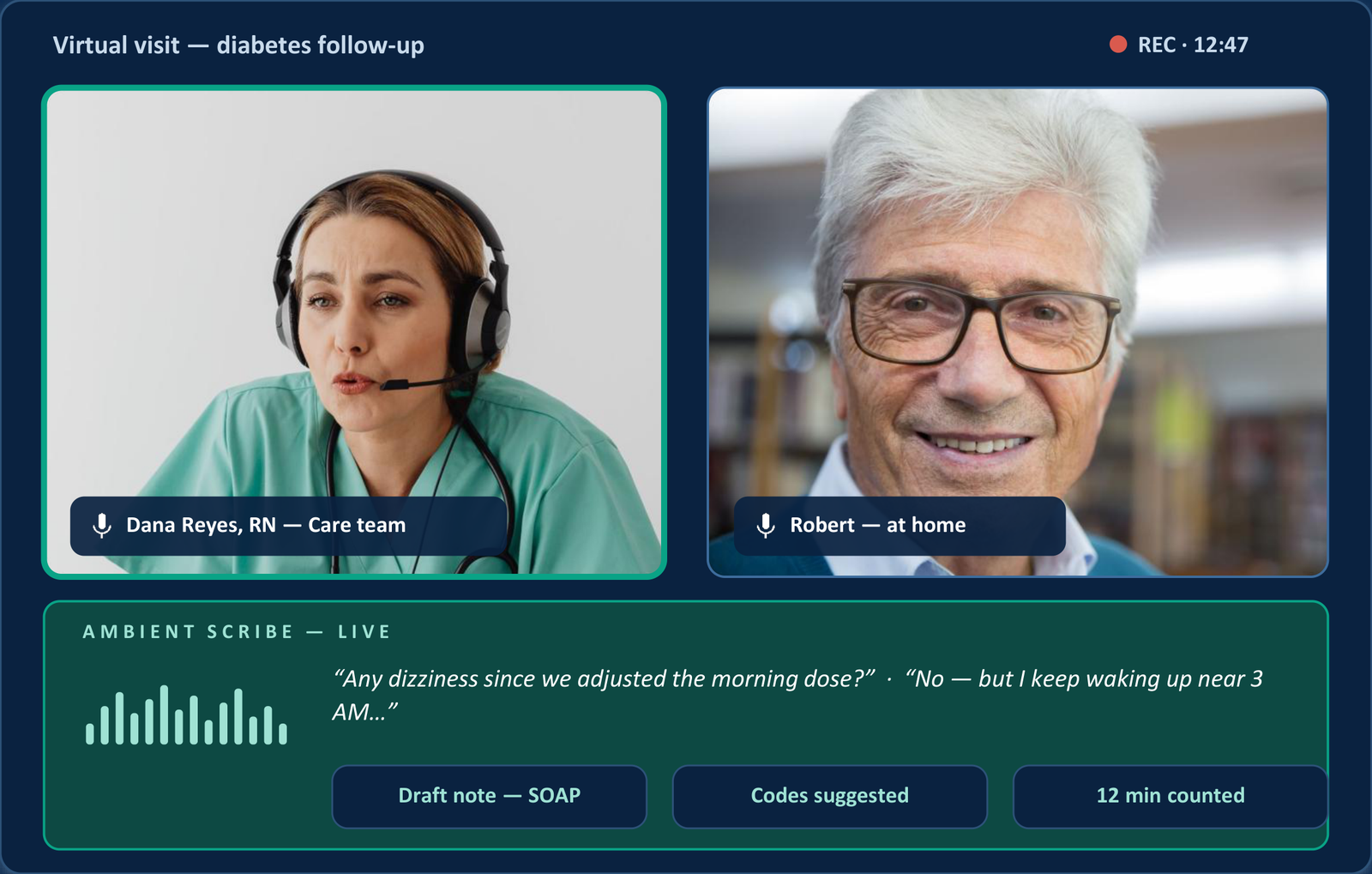
A virtual visit in progress: a care manager and a patient on video, with an ambient scribe panel below showing the live transcript and three outputs — a draft SOAP note, suggested codes, and 12 minutes counted.
Illustrative scene — the walkthrough runs a real virtual visit.
  • Scheduled like any other visit

    Virtual, telephone or in-clinic in one scheduler — a virtual visit gets its own private video room.

  • Easy to join

    One tap on a simple link, with a connection check before the first visit.

  • The scribe listens, the clinician looks up

    The conversation becomes a structured draft note as the visit happens.

  • Nothing to reconstruct later

    Draft note, suggested billing codes and visit minutes land together — your clinician reviews and signs.

Minutes counted The minutes are counted as the visit happens — the same minutes the month's billing evidence runs on.

Payer programs

Design the program once. Run it per payer contract.

Each payer contract asks for a slightly different program — its own visit cadence, its own quality measures. Define the program once, with measures drawn from industry-standard catalogs like HEDIS and Medicare Stars, then run it per contract, per line of business, per contract year.

  • One design, many contracts — the cadence and the measures are defined once; each payer contract carries its own rules and its own contract year.
  • Month-end is a report, not a project — per contract, the month shows which patients earned a bill, with the evidence attached: the readings, visits and activities that actually happened.
  • One short, caught in time — patients one requirement away from a billable month surface as work while there is still month left to fix it.

At two thousand enrolled patients, month-end in a spreadsheet is a week of reconstruction — and it grows with the panel. A bigger panel shouldn't mean a bigger billing team.

Program month April · mid-month
Payer contract Medicare Advantage 2026 contract year · its own cadence & measures
  • 2,412 enrolled
  • 1,904 billable so far
  • 137 one short

One short → today's worklist

C Patient C
  • Needs 1 more reading day

9 days left this month · on a care manager's worklist

Illustrative. Panel figures reflect platform testing, not customer results.

When a payer brings you a new program, yes is a design session — not a software project. The cadence and the measures come from catalogs payers already recognize — the program is defined, not built.

What it means for the bottom line

Four places the money stops leaking.

Unbilled months

Months you earned but never billed

Device days and minutes are tracked as they happen, so patient-months that qualify stop slipping through at month-end.

Device days

The 16-day threshold, watched all month

Patients drifting under the billable line surface mid-month — while a nudge can still save the month, not after it is lost.

Staff hours

Care managers start at "act"

The reading, ranking and drafting is done before your team sits down. Hours spent scanning charts become minutes spent deciding.

Panel headroom

Grow the panel, not the backlog

Each care manager covers more of the panel when the platform reads the data first — growth stops being a hiring decision.

No two programs leak in the same place. Bring us one month of your panel and we will show you where yours does — before you decide anything.

Before you ask

The practical questions, answered up front.

Your EHR stays the system of record

GlyntIQ assembles the supporting evidence. Your existing billing workflow submits the claim. Nothing gets ripped out.

It fits the team you have

One nurse covering a clinic panel, or forty care managers across a population — the work arrives the same way: ranked, with the reason attached.

Weeks, not a software project

Configuration, not code — set up around the way your team already works, rather than a new workflow to learn.

Built for the audit

Time, attribution and evidence are captured as the work happens, so a month’s claim rests on a record — not a reconstruction.

Talk to us

Bring us one month of your panel.

In twenty minutes we will walk it end to end — readings coming in, coaching going out, the worklist your care managers would see, and the codes each patient-month supports. Your program, not a canned demo.

  • Your device mix, your staffing, your payers.
  • A reply from someone who can answer clinical questions.
  • One conversation, not a sales sequence.
Need to bring your partners along? Download the two-page overview (PDF) to share with your team.

Prefer email? hello@glyntiq.com

We reply within one business day.